


Customer Case Study
Successful Digital Transformation and Well-Managed Government Structures
EGroupware as the Foundation for Administration at KDSZ Bavaria
>> Interviewee: Dominikus Zettl, KDSZ
Mr. Zettl, what are your responsibilities at the Catholic Data Protection Center of Bavaria (KDSZ)?
Zettl: “I oversee data protection for Catholic institutions in Bavaria. As an independent data protection supervisory authority, we at KDSZ Bayern support approximately 8,000 church institutions and consistently prioritize digital sovereignty within our own administration as well.”
“As a former attorney and specialist in criminal law, I believe it is important to consistently address this issue. Digital self-determination—that is, control over one’s own data and systems—must be taken into account from the very beginning when designing administrative architecture. I work toward this goal every day.”
How does the KDSZ use EGroupware? Which modules are important to you?
Zettl: “EGroupware is the central foundation of our internal administrative platform. It serves as the agency’s digital workspace and supports key processes such as complaints, data breaches, consultations, audits, and training sessions.”
In addition, we use EGroupware’s document management, knowledge management, and task management features. Collaboration tools such as Collabora Online, Rocket.Chat, and Jitsi have also been integrated. What’s convenient for us is that information is entered only once and then used throughout the organization.”
How can we ensure smooth communication with external users?
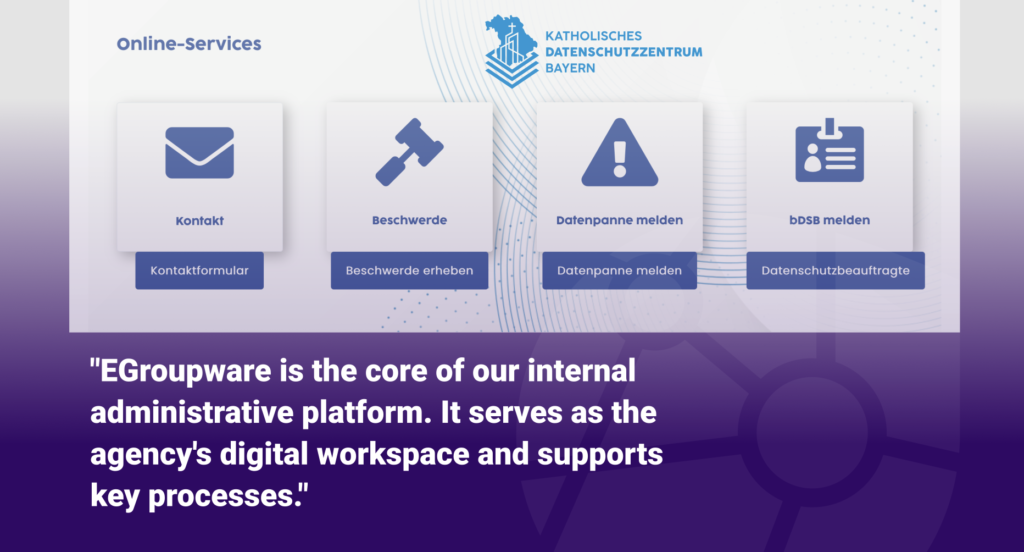
Zettl: “A digital data protection portal connects the agency to the outside world. Complaints, reports, and requests for advice are submitted via digital forms. The data is automatically imported into EGroupware—for example, into the address book. We have thus digitized administrative processes and linked them together via open interfaces. About 80% of the procedures are initiated online through the portal.”
How long have you been using EGroupware as the foundation of your digital strategy?
Zettl: “We have been using this solution in production for several years now. So we are a good example of how even smaller government agencies can implement highly integrated, scalable, and future-proof business and administrative processes.”
What is most important to you in this regard?
Zettl: What’s important to us is a seamless process chain—from the initial contact through electronic record management to final processing. The well-integrated, open overall architecture—comprising technology, processes, and organization—saves employees time. We also wanted a solution that is maintainable and adaptable over the long term, one that we can expand as needed.
For us, digital sovereignty isn’t achieved through individual open-source products, but through an interoperable, open foundation that integrates all the necessary components.
What technical solutions make EGroupware an “interoperable foundation” for you?
Zettl: “The platform uses open standards such as CalDAV, CardDAV, WebDAV, IMAP, JMAP, LDAP, and OpenID Connect. This allows it to be flexibly integrated into existing or future IT environments. At the same time, its architecture enables it to be operated both on-premises and in a sovereign cloud.”
Artificial intelligence was also incorporated with an eye toward the future. OpenAI-compatible interfaces allow for the integration of local or external language models without tying the architecture or data storage to specific providers.”

Your open-source digital strategy has been accepted for the community voting round of the 2026 National Open Source Competition. What motivated you to enter?
Zettl: “As a data protection supervisory authority, we are responsible for protecting sensitive personal data, while also advising numerous church institutions on their digital transformation. The issue of independence is more crucial than ever in this context.”
“With our solution, we want to demonstrate that digital sovereignty is not a matter of the size of a government agency. Open technologies make it possible to create powerful and modern digital structures—for large government agencies as well as smaller ones.”
We would like to extend our sincere thanks to Mr. Zettl for his excellent cooperation and look forward to continuing to develop the project together!
Note: Community voting will continue through September 30, 2026. If you would like to support the Catholic Data Protection Center of Bavaria’s strategy for an open and digitally sovereign administration based on EGroupware, we would appreciate your vote!
If you’d like to learn more about this specific approach or are considering how it might be implemented in your own organization, please feel free to contact us. We’d be happy to advise you on appropriate digital strategies, data protection, and open-source topics.

About KDSZ:
Data Protection Under the Church’s Responsibility
The Catholic Data Protection Center of Bavaria, in its capacity as a supervisory authority, monitors compliance with data protection regulations in Catholic institutions within the seven Bavarian (arch)dioceses.